From the 19th Century to Today: Egypt and Islam (PART TWO)
.png)
Al Sisi: massacres and control
The repression
While anti-Morsi celebrated the coup, the pro-Morsi protested and were angered. Media criticizing the coup were shut down, and hundreds of leaders of the Brotherhood were arrested overnight.
On July 8th, thousands of protesters had gathered outside the presidential palace to ask for the release of Morsi, believed to be still inside under military arrest. The soldiers shot and killed 58 protesters and injured more than 400. This violent episode was just the beginning of Sisi’s rule.
After the ousting of Morsi, leaders and members of the Brotherhood were hunted. In the months that followed, people could call TV hosts in live shows and denounce by name someone who worked for the Brotherhood and was a “dangerous terrorist.” Some managed to flee the country, while others were arrested. Protests continued in favour of Morsi, mainly in Rabaa al ‘Adawiya Square with around 85 000 people, but also in other squares and cities across Cairo and Egypt. On the 18th of August, a month after the coup, the sit-in and protest at Rabaa al ‘Adawiya Square was still ongoing; the army had had enough of it. Two days before, they killed 97 protesters in Ramses Square and had run out of patience for peaceful conduct. They sent the police and soldiers to block all roads to the square except one road and did what they called a "peaceful dispersal." In fact, it is probably one of the worst massacres of protesters in history.
Soldiers shot live bullets, snipers were on the roof and specifically targeted journalists, and the tents where protesters used to sleep were burned by policemen, just like a part of the hospital and the entire mosque where wounded protesters were treated. In a single day, at least 1 000 people were killed in Rabaa al ‘Adawiya and an-Nahda Square, and 800 were arrested (some of whom were tortured; others were summarily executed). Some military officials said they expected 2 000 protesters to be killed when they prepared their plan. The justification and how they convinced soldiers to do it is interesting. They accused the Muslim Brotherhood of being violent by kidnapping, torturing, and killing people who disagreed with them, and specifically soldiers. They accused the Muslim Brotherhood of staging attacks in Sinai against soldiers and of being terrorists (even before the party was officially declared a terrorist organization in December 2013 after a terrorist attack claimed by another group not affiliated with the Brotherhood). They even said the Muslim Brotherhood had weapons in Rabaa al ‘Adawiya Square and shot first while the army responded. In fact, after the massacre, the government showed 15 guns found in the sit-in and announced 8 policemen killed (remember, though, guns were easily available in Egypt at the time). So finding 15 guns isn’t surprising and is not proof of a terrorist plot.
But for the army, there were 3 other important justifications: firstly, the soldiers received testimonies from their officers who claimed they had infiltrated the protest and saw bombs, weapons, torture, and killing of soldiers; they even claimed leaders of the Muslim Brotherhood had apartments around the square where they did “sexual Jihad” (a term used in islamophobic rhetorics like in India, which claims Muslims rape or marry women to expand their ideas/religion). The second justification given to the soldiers was the former Mufti of the Egyptian Republic, Ali Gomaa, a prominent scholar of Al-Azhar who was Mufti from 2003 to February 2013, so he wasn’t the official Mufti at the time, but he still had more prestige than the new Mufti (who apparently refused to give a religious justification for the massacres). Ali Gomaa met soldiers who were sent to carry out the massacre and told them beforehand, "The Muslim Brotherhood are the heretics of our age, and when we kill them, God, His angels, and His Prophet are on our side." There is also a video of a speech he made in front of the entire leadership of the army (amongst them al-Sisi) where he said, “Shoot them in the heart … Blessed are those who kill them and those who are killed by them . . . We must cleanse our Egypt from this riffraff … They shame us … They stink. This is how God has created them. They are hypocrites and seceders … Stand your ground. God is with you, and the Prophet Muhammad is with you, and the believers are with you … Numerous visions have attested that the Prophet is with you. May God destroy them, may God destroy them, may God destroy them. Amen!” When the video leaked, he defended himself by saying he was talking about the terrorists in Sinai, but that isn’t really convincing, as his opposition to Morsi was known, and soldiers testified they met him and he said it again. Even in the mosques of military bases, the imams of the army repeated over and over that the protesters were “khawarij” and deserved to be killed; it was a religious duty. The third justification used was that there were “20 000 jihadists who came from Gaza to fight us.” There was no basis or proof, but that doesn’t matter for the propaganda. This rhetoric of Hamas helping and fighting with the Muslim Brotherhood would be used again in the trial of Morsi.
Between the 3rd of July 2013 and April 2014, the government massacred more than 2600 protesters, injured thousands, and arrested around 20 000 members of the Muslim Brotherhood, who would mostly be tried for “terrorism.” The war against the former regime was a “war on terrorism,” and all means were necessary and justified to fight against them. The repression was so violent that it effectively deterred any protests against the army. Thousands of people arrested remained in jail for months or even years awaiting their trials. In the end, in grotesque and quick trials, hundreds were condemned to the death penalty. In March 2014, in a single trial, more than 500 were condemned to the death penalty. Although most of the condemned saw their sentences turned to life in prison or lengthy sentences (10, 15, 20, or 25 years), others still had their death sentence maintained and were executed. Another trial saw 600 condemned to the death penalty before most of the sentences were overturned. But prison was not a much better option; in some cases the result was the same: death. As prisoners were victims of torture or medical negligence, some died, like former president Mohamed Morsi, who died of a heart attack after years of being untreated for his diabetes. Old leaders of the Brotherhood, like Akef, also died in the same conditions in prison after medical negligence. In prison, most of the prisoners are in overcrowded cells (around 35 prisoners in 20 m²); the leaders are completely isolated 24/7, with cameras watching their every move in their cells, and contact with the outside world is either restricted or nonexistent.
My family knew a woman whose husband was in jail for being in the Brotherhood’s government; neither she nor the lawyer knew where her husband was jailed, they never visited him, and after the family’s assets were seized, she fled to Canada with little to no news from her husband.
This case is one of hundreds of similar cases. The state systematically seized all the assets of the convicts. Brotherhood members were the main target, but not the only one. Other Islamists who opposed the coup were arrested, like former aspiring presidential Salafi candidate Hazem Abu Ismail, who was jailed and condemned in different cases, and when he was finally about to be freed from jail in 2019, he was condemned in another case dating back to 2012. This is systematic; the government uses any case possible to keep those deemed “dangerous” for their power jailed as long as they can. Hazem Abu Ismail has also been subject to medical negligence and solitary confinement for years, and his son has also been jailed. Dozens of relatives of politicians or political opponents have been jailed; sometimes even as punishment when this opponent managed to flee the country, one of his relatives still in Egypt was jailed. Even non-politicians are jailed, like Sheikh Mahmoud Shaaban, a prominent imam (graduated from al Azhar, though he is salafi) who appeared several times on TV to debate people on hijab, Islamic politics, jizya, etc… He used the freedom given by Morsi’s rule to speak about sensible religious topics and even criticize Morsi. Every Islamic group benefited from Morsi’s rule, as speaking about religion wasn’t as sensible or as risky as before or after him. He also filmed his Khotba and posted it on social media; in some of his Khotba, he wasn’t scared to denounce the killing of protesters that happened after the coup. He was arrested for being part of a “terrorist organization,” with the proof being a trip of 4 days in Syria, where he met and gave a speech to the Free Syrian Army (which wasn’t considered a terrorist organization by the Egyptian state); like thousands, he is still in jail after more than 10 years. He was freed in 2021 but arrested 4 days after his release and brought back to jail for old cases (again, it's to keep him in jail). He complained of being beaten, insulted, and having feces thrown at him by guards of the prison and did several hunger strikes, the latest being in November 2025 to complain against the impossibility of praying decently in a pure space, as he has no water to clean it.
This isn’t the only case; there are testimonies of prisoners who can’t pray decently. Some testified they were forced to pray naked or not pray. Mahmoud Shaaban, in a leaked letter, denounced a guard called Issam al-Alfi, a prison guard and torturer who said to one prisoner, “When you meet your God, let him give me a phone call.” We see that torturers, whether they are under Nasser, Mubarak, or Sisi, have not changed in their practices nor behaviour.
Today, it is estimated that there are 60 000 political prisoners in Egypt, including Muslim Brotherhood members, human rights activists, political opponents, journalists, etc. But jail isn’t the only thing that can happen to political opponents in Egypt; they can simply disappear, like 3,000 people. Some only temporarily before being tried officially in front of a court, while others can be tortured to death or executed; such is the case of hundreds of people, while the fate of others is still unknown after years. Forced disappearance does not affect just poor and unknown people but even known politicians. Recently, a mass grave with around 300 bodies was discovered in North Sinai, where the army fought against terrorism, a fight during which the army imposed a total blackout on North Sinai and forcibly displaced 150 000 people.
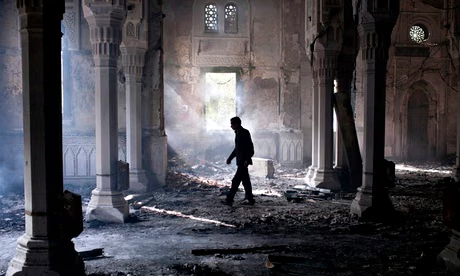
An important part of the regime change was (and still is) propaganda. As the army took over, they took control of all national channels, newspapers, etc… They also closed down several independent news outlets and, as said previously, targeted and killed journalists in protests so only “their truth” could come out. They rewrote the entire history of Morsi, the Muslim Brotherhood, and the events after the ousting.
In an interview dated to 19 August 2013, given by the General of the Police to the French news outlet Le Monde, he spat out all the propaganda used by the new regime: “The Muslim Brotherhood sees only 2 outcomes: either they rule Egypt or they burn it” (here he paints the Brotherhood as fully being responsible for the chaos). Morsi liberated 25 000 dangerous criminals (here he depicts Morsi as being a supporter of violence, criminals, and terrorists). The protesters are paid by the Brotherhood (so their demands are not legitimate, as they are paid to protest; they don’t protest of their own will). The protesters are not peaceful; they are armed terrorists (this sentence legitimizes the use of violence against them). The Brotherhood was supported by Türkiye, Qatar, the USA, and Israel, with whom they conspired (this is a masterpiece in Sisi’s propaganda; the Brotherhood was supported by foreign forces and not by Egyptians. They conspired against Egypt and are traitors.) Morsi was an agent of Hamas; he wanted to sell them a part of the Sinai Peninsula. In a plan proposed by Obama, he also planned to sell the south of Egypt to Sudan, and he approved the Ethiopian plan to build a dam that will cut off 3/4 of the water source of Egypt. He also planned to rent for 5 years all touristic and antique places to Qatar, like the pyramids. (This completely absurd accusation is also to support the idea that with the coup, the army saved the country from being sold out by traitors and foreign agents. It’s even more ironic when Sisi gave 2 islands owned by Egypt to Saudi Arabia; it makes us think, who really sold the country ?) All the elements mentioned by the General of the Police were used by state media, which of course pretended that all of this was a secret conspiracy that prompted the army to intervene and prevent the country from ending in a civil war like Syria (this specific reference embarrassed the Egyptian state propaganda when, in December 2024, the Syrian civil war ended with the victory of the people).
From the 2011 revolution, armed groups appeared in the Sinai region with the goal of attacking Israel; they did some attacks against Israel, but they had very few members. But the ideas of Al Qaeda and other groups were shared by some in the public space; even more so since the revolution, between 2011 and 2013, freedom of expression was at its peak in Egypt. Terrorist attacks did increase after the 2013 coup (while during Morsi’s rule, there was only one major attack); they primarily targeted the government, police, army, and Christians, but also people involved with the ousting, like the prosecutor, judges, ministers, or Ali Gomaa, who escaped an assassination attempt in 2016. Several Islamist groups emerged in North Sinai after July 2013, with some pledging allegiance to broader organizations like ISIS and al Qaeda, while others remained independent, like the Hasm movement. Since 2013 hundreds of attacks have taken place all over the country, but in 2023 the government announced the victory over terrorism.
Was the Muslim Brotherhood behind those attacks? There are probably former members of the Brotherhood who joined armed groups, but the organization itself never took arms, and the leadership never endorsed any attack. But as one of the Brotherhood leaders said to an American representative in the last days of Morsi’s rule, “The international reaction is important; you cannot let a coup take place in Egypt without any reaction. If you do so, you show to the Egyptian youth, and especially the Islamist youth, that democracy is impossible in the region.” This explains exactly why so many armed groups emerged after the coup. The democracy solution put the Islamists in power, but it didn’t matter; they were ousted and massacred by the army, so some thought the only solution to achieve political victory against a violent and repressive state is violence. To give a scale of the violence, between 2013 and 2023, the attacks killed around 1500 Egyptian civilians, more than 250 foreigners, and 3300 soldiers/policemen and injured more than 12 000 soldiers/policemen. The number of terrorists was estimated to be 12,000, amongst whom there were some Arab tribesmen who simply opposed and fought the government for different reasons. The government also gave weapons to Arab tribes so they could fight with the army against terrorists.
Al Azhar
Al-Azhar’s role during the revolution was almost nonexistent. Though some imams and scholars participated in the 2011 revolution, the institution itself remained on the government side, calling for an end to the protests and the bloodshed.
The Grand Mufti even issued a fatwa to not pray Jumuaa in mosques on Friday, the 28th of January (the Friday was a day for huge protests). But when Mubarak was ousted, the Grand Imam Ahmed al Tayyeb issued a statement to congratulate the people and said al-Azhar supported the will of the people from day one but kept its distance to avoid more bloodshed. With a temporary government and a revolution, voices rose inside Al-Azhar to regain independence from the state; the Grand Imam also wanted more independence and managed to change the nomination of the future Grand Imams. Since Nasser, the Grand Imam, was nominated by the president, but in 2012, this was abolished and the previous system (before Nasser) was reinstated, a Council of Elders will designate their candidates for the Grand Imam and vote for him. Al Azhar also wanted to provide guidance for the new constitution by stating its support for a democratic state (according to Grand Imam Ahmed al Tayyeb, “There is no such thing as an Islamic state”), and Al Azhar provided a list of rights guaranteed by Islam that should be written in the constitution. The grand imam also met several political leaders and called for the army to leave the political scene.
The Muslim Brotherhood supported an independent institution of Al-Azhar, free from any influence; this institution could hold the state accountable when it doesn’t respect Islamic law. In the draft constitution of the Brotherhood, Al-Azhar would play an important role, as they would be consulted over any law to see if it respects the Sharia. Whereas Al-Azhar as an institution was neutral towards the Brotherhood, the scholars had their own opinions, with some supporting them, while others disagreed with the Brotherhood or even hated them. In any case, when the military coup happened, the grand imam of al-Azhar was beside al-Sisi, and Ali Gomaa, former mufti of the republic, called for the massacre of protesters. We don’t know when the Grand Imam knew of the coup; was it several days or weeks before? Or on the same day it was announced? What we know for sure is that Al-Azhar as an institution sided with the coup, while scholars of Al-Azhar on a personal level either denounced it or even fled the country to live in Türkiye, Qatar, or other countries. Scholars of Al-Azhar who slightly opposed the government had troubles even if they were not arrested, like Sheikh Muhammad Jebril, imam of Amr ibn al-‘As Mosque (one of the most important and the oldest mosques in Cairo) for 27 years; he was dismissed and banned from preaching or leading prayer in any mosque owned by the Ministry of Awqaf of Egypt. The reason is during a duaa he asked Allah to “punish the tyrant leaders whose commands negate the divine orders and punish those who have shed our blood and orphaned our children. Punish all manipulative media practitioners and corrupt politicians.” He never said any name, but he obviously talks about Sisi and the government, which was deemed “mixing politics and religion,” something officially forbidden to Imams in 2014. Which is quite hypocritical when everything that Al-Azhar does IS political.
The Grand Imam met Al Sisi on different occasions, met several ambassadors and presidents of countries, travelled on official visits to other countries, and even met politicians like French far-right leader Marine Le Pen. Al-Azhar even supported the decision to isolate and blockade Qatar, as it is “a regime that supports extremism and terrorism.” Fighting against terrorism is one of Al-Azhar’s major roles under Sisi, but that decision is still political.
Under Sisi, the role of Al-Azhar is plural: Al-Azhar is representing Islam in Egypt and the world. They want to be the most important Islamic institution in the world. Al Azhar also fights against terrorism (just like in the 90s). And finally, an important aspect since Sisi (even though it started before) is interfaith and peace dialogue mainly with Christians.
Al Azhar, as an institution representing Islam, participated in several conferences to establish and define “what is the real Islam.” Like the Grozny conference and the World Sufi Forum in 2016, with the participation of the Mufti of the Republic Shawki Allam in the World Sufi Forum, and in the Grozny conference, all of the highest leaders of Al-Azhar: the Grand Imam Ahmed al-Tayyeb; former Mufti of the Republic Ali Gomaa; actual Mufti Shawki Allam; President of Al-Azhar University Ibrahim Salah al-Hudhud; Chairman of the Supreme Council of Sufi Order in Egypt Abdel Hadi al-Qasabi; and even the future Minister of Awqaf, Usama al-Azhari. In both conferences, they heavily criticized the Salafis/Wahhabi thought and denounced the terrorism of “Salafi-Takfirists.” In the Grozny conference they designated “Ahl al Sunna al Jama’ah” (so the people of the Sunnah and the majority) as being the 4 schools of law; the Ash’aris, Maturidis, and Ahl al Hadith (they specifically said “who adopted Tafwid”); they also said ahl al sunnah wal jama’ah are the ones who follow the path of spirituality of Al Junayd and the imams who followed him (Sufism). Al-Azhar pushes Sufism, and a lot of Azhari scholars are themselves members of Sufi Tariqas or even imams of such Tariqas. For example, Ali Gomaa (former Mufti) is the imam of a sub-tariqa inside the Shadhiliyya; one of his students is the famous Sufi shaykh Yosry Gabr. Ali Gomaa and Osama al Azhari (minister of Awqaf) participated in a dhikr gathering in 2025 to commemorate the Mawlid of the Sufi saint al-Sayyid al-Badawi.
What is interesting is the people gathered here ended their dhikr chanting “Tahiya Masr” (“Long live Egypt”). An obvious nationalistic expression in a religious event, in front of scholars close to or working for the state, is probably not spontaneous. Sufism is a weapon; they present Sufism as the traditional Egyptian Islamic expression against Salafism, which is foreign to Egypt and is recent. Al-Azhar opposes Salafism, as Salafis disagree on theological questions with the Ash’aris (Al-Azhar is entirely Ash’ari), and Salafis don’t recognize the legitimacy of Al-Azhar as an institution. To oppose the influence of Salafis, Al-Azhar will say the niqab is not religious but only cultural, permissible but not recommended nor obligatory (which is not true; schools of law treated that question, and almost all of them agreed that “in times of fitna, covering the face is mandatory,” so it is religious, not just cultural). The niqab has been targeted in Egypt; it is presented as being completely foreign to Egyptian society, starting in the country in the 1970s/1980s (allegedly, though older pictures prove the contrary), and the niqab is a symbol of religious extremism or political Islam, and some argue it is a matter of national security.
Some places have banned the niqab; Cairo University banned it for their professors, and even Al-Azhar University in 2008 banned the niqab in all-female classrooms and dormitories. And some parliamentarians and lawyers tried to ban the niqab in the streets; a draft law was made in 2018 but was not debated in the Parliament, and in 2019 a lawyer filed a lawsuit to ban the niqab but was rejected by the State Council. Niqabi women can have trouble with getting some jobs; high-ranked jobs are mostly off-limits. There was even a journalist in 2015 who went further than the niqab and called for women to come to Tahrir Square and take off their hijabs. But Al-Azhar defends the hijab and states it is mandatory; there is no discussion about it.
Al-Azhar is opposed to Salafism and political Islam, as it sees them as a door to terrorism. Several statements of Al-Azhar are made to denounce terrorism and “fight it.” Dar al-Ifta (the institution that issues fatwas to all Egyptians) made a 218-page book called “The Ideological Battle” to refute terrorism. Al Azhar Observatory for Combating Terrorism (founded in 2015) adheres to the state propaganda that the Muslim Brotherhood are terrorists; in a statement, they said, “The Muslim Brotherhood follows ISIS’s lead.” There was even a fatwa that forbade Egyptians from renting an apartment to any Muslim Brotherhood, as it would be used to “prepare attacks.” Al Azhar also said that the Egyptian army, by fighting against terrorism, is doing Jihad. This gave religious legitimacy to the army’s actions in Sinai, which were praised on another occasion by al Azhar. At every terrorist attack around the world, Al-Azhar issues a statement to condemn it and denounce the terrorists behind those attacks. There are plenty of other statements on terrorism. But on a more implicated level, for every death penalty for terrorism (or any other reason), the Mufti of the Republic has to sign it and agree to it.
When protests against the military coup erupted on Al-Azhar campus in 2013 and 2014, the administration expelled students involved and fired teachers supportive of the protests. The university also called on the police to intervene and scatter the protesters, resulting in dozens of injuries and hundreds of jailed students. The University of Al-Azhar also collaborates with foreign governments, for example Uzbekistan, only accepting Uzbek students who studied religion in state-approved religious schools back in their country, or even denouncing students who were not attending lectures and exams and were suspected of learning Islam from sheikhs (mostly Salafis) outside of the university.
Al-Azhar also plays an important role in interfaith dialogue, with several meetings between the Grand Imam and the Coptic Patriarch or the Catholic Pope (in the Vatican or during his visit to Egypt), and meetings between the World Council of Churches and the Muslim Council of Elders in Cairo (during one of which they affirmed that full citizenship with equality of rights should replace the dhimmi status). Al-Azhar also issues statements to congratulate Christians on their religious festivities like Christmas, New Year, or Easter. Al Azhar even encouraged Muslims to give gifts to their Christian counterparts for Christmas and said that whoever rejects the idea of congratulating Christians on their festivities is “raising the tone of violence and hatred against the other who dissents in religion; this is an interaction that indicates a wrong understanding of the texts of religion and leads to a threat to public peace and contempt for religion, which entails a legal penalty and a religious violation.” Interfaith dialogue was done even before Sisi’s rule, but since terrorists attacked Christians, Al-Azhar really insisted on religious tolerance. Going as far as refusing to call Christians “disbelievers.”
On one occasion, a sheikh called Salem Abdul Jalil, who worked for the ministry of Awqaf, was invited on a TV channel and was making the exegesis of a Surah, in which he talked about the “kuffar” (disbelievers) and said, “It is the Jews and Christians.” This comment shocked some Egyptians and prompted the Ministry of Awqaf to ban him from any position and preaching in any mosque. Christian lawyers prosecuted him for “religious contempt.” Then the sheikh didn’t apologize but clarified his position: “Just as Christians consider Islam a corrupt doctrine, we as Muslims consider Christianity a corrupt doctrine. But it doesn’t mean Islam encourages the killing of people from other religions.”
Drama rose again when Ahmed Karima (an Azhari scholar) went on TV and affirmed Jews and Christians are believers who will go to paradise, and Christians who are soldiers and died fighting for their country are martyrs and going to paradise. He also said, “We are 7.5 billion in the world; how come only 2 billion will enter paradise? It’s not just.” He affirmed Shias are Muslims who make mistakes “like all of us have mistakes,” but in a TV debate, he made takfir of the Salafis, saying, “We worship Allah, and they worship al-Lat, the sculpted god,” and said, “The Salafiyya are kuffar/disbelievers with that belief” (even though in a later TV show, he said, “I never made takfir of the Salafis”).
But the biggest drama was when former Mufti of the Republic and prominent Al-Azhar scholar Ali Gomaa, in a TV show where he answered questions asked by children, when asked about Jews and Christians, said, “Who said only Muslims will enter paradise? This is false information,” or when asked about Christmas, he said, “If by Christmas you mean celebrating the birth of Jesus, then there is no problem, as we Muslims celebrate the birth of our prophets.” Several scholars (some from Al-Azhar) reacted strongly by calling him a heretic and saying he is misguiding people. T
he justification Gomaa and others use for that idea is apparently a quote from al-Ghazali from which they understand that the disbeliever who will go to hell is only the one who rejected Islam after fully understanding it in its truth and entirety. But that poses several problems; if it were so, then there is no point in da’wah. On the contrary, if everyone by default will go to paradise, we should never talk about Islam with a non-Muslim, because if we do and they don’t convert, by this understanding, they will go to hell because of us. That’s without talking about all the verses and ahadith that don’t support their logic. This opinion that Christians and Jews will go to heaven was not really the opinion of Dar al-Ifta in 2013, which stated, “A person may be judged in this world as ostensibly being a disbeliever because he did not enter Islam, when in fact he did not doubt Islam in the first place. Such a person may be excused before His Lord the Almighty because the message of Islam did not reach him in a clear manner or because the call did not reach him at all. Therefore, he will be among those whom Allah will test on the Day of Judgment.” This change of opinion since Sisi took power is not surprising. In a weird exchange with Azhari students who just finished their PhD, Sisi posed as a teacher of religion and told them, “I will not speak of Sharia; I will speak of our God, because I speak of our God really well. Who told me that ? Our religion.” speaking about freedom of thought and belief he said “this is a religious order, not just an idea”, he then asked the students “you are guardians of what ?” they answered “Guardians of the religion. Guardians of the Sharia,” he corrected them, saying, “No, you must be guardians of freedom.” He went on and said, “God gave us humans a choice to believe or not; if you don’t believe, you are free. Is there something greater than this?”
There are other new opinions that go against centuries of Islamic heritage that Al-Azhar holds nowadays. For example, in 2019 and again in 2022, the Grand Imam of al-Azhar questioned polygamy, which he called a “right, but a restricted right.” He said, “One wife is enough,” and “Polygamy often is a great injustice to the wife and the children,” thus opening the door to support stricter regulation on polygamy, something some people have called for for years; some even asked to ban polygamy completely.
The same year, 2019, the government launched a campaign that stated, “2 children is enough.” We can suppose the comments of the Grand Imam are related to that campaign launched against overpopulation, but we can’t be a hundred percent sure. What we are sure of, though, is that Al-Azhar received pressure to change and “reform Islam,” whether it’s from secular people or even the state and Sisi himself. Some even went as far as to reject the work of all the previous scholars and call for a “new beginning,” like the Cairo University president who debated with the Grand Imam of al-Azhar, or Islam el-Beheiry, a TV host who doubts the authenticity of ahadith and who was called an apostate by the president of al-Azhar University (after that he was fired and had to issue an apology). Islam el-Beheiry was even jailed for blasphemy for a year (after an initial 5 years, reduced to a year and even less after he received a presidential pardon.) After being freed, he vowed he would continue to fight against “Islamic extremism.” Al Azhar, under pressure, has created a committee tasked with reviewing and erasing anything deemed as “inciting violence” from their curriculum. And the government even tried to dictate every khutba of Jumuaah, but al-Azhar refused and managed to avoid such a thing (though since Nasser, the subjects are given nationwide in mosques that are under control of the Ministry of Awqaf).
Sisi also tried to make the divorce only by paper, not a “verbal divorce,” which Al-Azhar refused, as verbal divorce is Islamic. They were heavily criticized and accused of being close to the Muslim Brotherhood (though al-Azhar supported the coup). It may explain why a proposed law, which forbade any criticism of Al-Azhar, was not voted on. Al Azhar receives criticism from people deemed “extremists” who don’t recognize the legitimacy of Al Azhar, and they get criticisms from people who see Al Azhar as being too extremist; they are mostly secular if not atheists (though atheism is not recognized in Egypt, some people are anti-religion but avoid making it too clear to avoid trials for blasphemy). But still, al-Azhar is supportive of the government and its policies, like Imam Khaled al-Jundi (a scholar who goes on TV and was the second highest paid scholar in Egypt in 2018), who said, “It is neither an insult nor a fault; I will say it proudly: I am the sheikh of the Sultan, because if you do not say that, you will remain without privilege.” and “I ask God to gather me with Sisi on the Day of Resurrection." The pinnacle of his declarations is "Prisons in Egypt have restored human vitality and activity." The most recent case of Al-Azhar support to the government is the newly opened Grand Egyptian Museum, one of the biggest museums in the world, inaugurated in 2025 by Sisi and entirely dedicated to Ancient Egyptian civilization. It was called “a national monument and a universal mosque of knowledge” by Dar al Ifta.
Debates erupted on social media about people celebrating its opening, with some scholars saying, “We as Muslims shouldn’t celebrate it; it's celebrating polytheists.” The minister of Awqaf (Usama al Azhari) answered by saying, “The ancient Egyptian civilization is not a civilization of polytheism and paganism but was a civilization of monotheism and faith in God,” thus giving a religious legitimacy and rewriting history. Thousands took this sentence (or its meaning) and used it to defend their nationalist celebration of the museum online. It is quite hypocritical to see Al-Azhar defending the ancient Egyptian civilization while they remain silent on Muslim graves being completely destroyed by the government to build a road. Some of those graves include the grave of Imam Warsh (the famous reciter) and Imam ibn Hajar al ‘Asqalani (at least for this one they displaced it, whereas others were destroyed by bulldozers, and the road is built directly on top). 19th-century mausoleums also got destroyed with no plan to rebuild them elsewhere, and in general, other graves have been completely neglected, like the grave of Imam al ‘Izz ibn ‘Abd al Salam, which is a pile of rubble.
On an international level, Al-Azhar regularly condemns blasphemy of Islam and also condemns terrorist attacks. They want to play an important role internationally, which has been the case since the 7th of October 2023, when Al-Azhar defended Palestine and denounced the Zionists’ crimes by issuing statements. Al-Azhar also opposed plans to displace Palestinians and said it is a duty for them to fight for their land. They even had to retract a statement against Israel because the government found it too harsh. But the Mufti of Egypt, Nazir Ayyad, rejected a fatwa issued by the International Union of Muslim Scholars, which stated, “All Muslim countries are under a legal duty to intervene immediately militarily, economically, and politically to stop this genocide and comprehensive destruction and to impose a siege on Israel.” Nazir Ayyad said, “Calling for jihad without regard to the nation’s capabilities and its political, military, and economic reality is an irresponsible act that contradicts Sharia principles.” He also said Jihad must be declared by states, “not in statements issued by entities or unions that lack legal authority and do not represent Muslims either religiously or in practice” (we can sense a bit of rivalry between Al-Azhar and the IUMS for who represents Muslims). He also said, “Supporting the Palestinian people in their legitimate rights is a religious, humanitarian, and moral duty. However, this support must be provided in a way that truly serves the interests of the Palestinian people and not to advance specific agendas or reckless ventures that could lead to further destruction, displacement, and disaster for the Palestinians themselves." and concluded by calling for a de-escalation in Gaza as being the way to go. This fatwa is obviously holding accountable the inaction of Sisi, and the answer of the Egyptian Mufti is here to protect him and support his actions, which were mere peace negotiations (and by the way, Sisi signed a 30 billion dollar agreement with Israel in parallel to those negotiations).
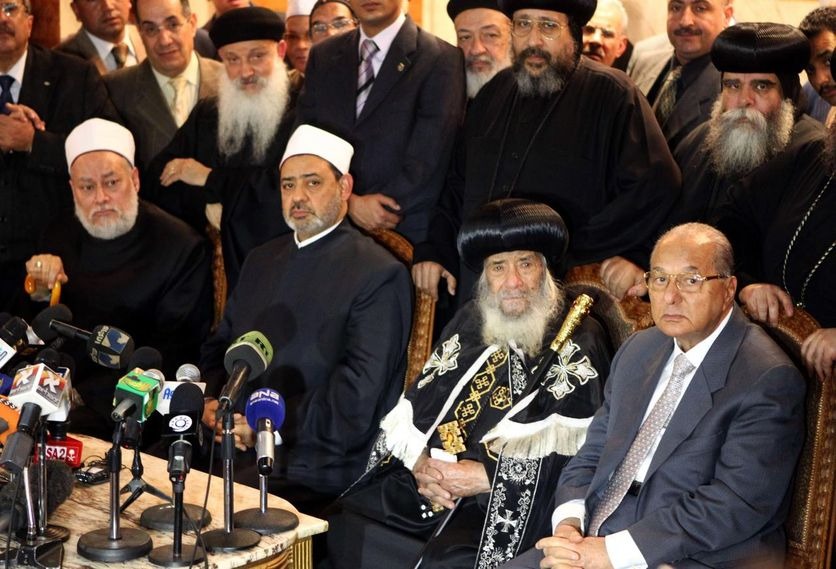
Ali Gomaa (left) with Ahmed el Tayyeb (middle) meeting the Coptic pope (right)
3. Salafis
The Salafis are numerous in Egypt; it is one of the most prominent groups with Sufism. But contrary to Sufis, they don’t recognize the legitimacy of Al-Azhar, as they have different creeds. They openly dislike each other, but they have a weird relationship in Egypt. As Al-Azhar is the main representation of Sunni Islam in the country and the one who holds power, the Salafis depend on Al-Azhar’s decisions for several things. For example, giving fatwas, lectures, and preaching in mosques—this is all with the blessing of the Ministry of Awqaf. So there are Salafis who have the right to do all of this—giving fatwas, lectures, and preaching in mosques—and others who don’t have this right. Like Sheikh Mustafa al ‘Adawi, who had his right revoked in 2020 and has been arrested on 2 different occasions (both times he was freed on bail and didn’t have a trial), which shows the government openly dislikes some of his opinions. The first time was in 2020 when he called to boycott French products over the caricature of the prophet and called Macron a criminal. In 2025, he was arrested and then released on the same day (and all of his videos were deleted by the government, but he managed to repost them) after he was asked about the new museum and answered, “I fear for a Muslim person that his heart may become contaminated with love for Pharaoh and his people,” and said this museum should be a reminder of the Kufr of Firawn, not to praise him or people like him. He also opposed other positions of Al-Azhar, like congratulating non-Muslims on their religious festivals. Other prominent Salafi/Madkhali scholars include the famous Sheikh Mohammed Said Raslan, known in the Salafi spheres across the world, with hundreds coming from several countries to come and study under him in his village of Subk al Ahad. He openly supported Sisi and called anyone criticizing Sisi a traitor. Though he said it is forbidden to criticize a Muslim ruler, he criticized the Emir of Qatar and the president of Türkiye, as there were tensions between Egypt and the 2 countries accused of supporting the Brotherhood. He still saw his permit to preach revoked after he went off the script during a Khutba and answered to attacks made on him by a pro-Sisi TV host. The Ministry of Awqaf revoked his license to preach, and Raslan called his supporters to respect the decision. After the decision, an Azhari scholar was sent to preach in the mosque, and Raslan heavily praised him, saying, “The ministry (of Awqaf) showed us a great deal of respect. I can’t label myself a student of religion; I am not a Shaykh, and still the Ministry, after they made their decision, sent us a scholar whom we can listen to and learn from!” In the village of Raslan, as said before, there are hundreds of foreigners who come to learn from him. One of those foreign students told me there were several police controls, and one time they even searched the dormitories of the students. Foreigners who didn’t have their residence permits were jailed and then expelled from Egypt. This type of control is not specific to this village; foreign students in some neighbourhoods in Cairo have to beware of this, but the common thread is that in this village and in the neighbourhood where police make controls, there are a lot of foreign Salafis. In neighbourhoods where it is mostly foreign students of Al-Azhar, there is little to no police control. Al-Azhar issued a statement to express its sorrow over the death of Salafi scholar Abu Ishaq al-Heweyni. So the relationship between Salafis and Al-Azhar isn’t a simple relationship. Just like the relationship between the state and the Salafi scholars. Some Salafi scholars had to explain themselves in front of a court and clarify their positions on politics, as some people accused of terrorism cited their names as their references. Sheikh Muhammad Hassan and Sheikh Muhammad Hussein Yaqoub had to explain themselves in front of a court, and they had to state their differences with the Muslim Brotherhood and state that they don’t engage in politics, and Sheikh Yaqoub even went as far as saying, “I am not a scholar, nor a Salafi; I’m a Hanbali.”
While most Salafi don’t partake in politics, as said previously, there were Salafi politicians, and if most of them supported the Muslim Brotherhood and protested against the coup, one of the most prominent Salafi parties, Al-Nour Party, supported Sisi in his coup and the presidential elections. But since 2013, their popularity has collapsed; they don’t have any support. In 2012 they had the second most seats in the parliament; nowadays they can’t have even one seat. The loss of support can be explained because they supported the secular coup against Islamists, which obviously displeased their supporters, who saw this move as treason. They also have to convince Salafis to vote (they reached out to Salafi scholars to support them, but they refused, saying they were against the concept of elections). They also can’t attract non-Islamists/Salafis, as they are seen as extremists by the seculars. Nowadays they are still useful to the government (which refused to ban religious parties just to protect this party) as they defend the state; for example, Yasser Borhami, a prominent leader of the Salafis, defended the coup and said the Brotherhood wanted to shed blood (legitimizing their massacre). Most recently, he rejected the IUMS fatwa, which called for Jihad against Israel, calling it “unrealistic” and “contrary to Egypt’s 1979 peace treaty with Israel.” Al Nour party also provides an Islamist party, so an alternative to violent Islamist groups (just like the Brotherhood in the 1990s). Just like the Salafis scholars are recognized and allowed to preach publicly to provide an alternative to Al-Azhar and avoid people who dislike Al-Azhar listening to preachers who would oppose the government. Al-Azhar can be seen being mocked online and is discredited by Salafis (not scholars), who disapprove of Al-Azhar’s scholars and the Sufism of Al-Azhar. If Salafism were flat out forbidden, people would seek other means of expression and not just study/listen to Salafi/Madkhali scholars.
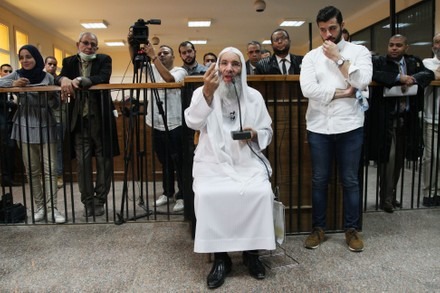
Sheikh Muhammad Hassan testifying in court
4. Muslim Brotherhood
The Muslim Brotherhood is accused of everything against the Egyptian state; any criticism against the state is the hand of the Muslim Brotherhood acting behind the scenes, according to the state propagandists. Criticism of Egypt's inaction towards Gaza? It is the Muslim Brotherhood and the Zionists, as the al Minya court, which sentenced 1200 Brothers to death (most of them got overturned to life sentences), said, the Brotherhood are "enemies of the nation" who came "from the depth of hell" to "teach their book, the Talmud." Which doesn’t make any sense, as Morsi was condemned to death (overturned to a life sentence) for "plotting and organizing his escape from prison with the armed groups of Hamas and Hezbollah" back when he was jailed in 2011, and after the prison got attacked by unknown gunmen, he escaped amongst thousands of prisoners (though some testimonies of prisoners point to an undercover government operation to spread terror with thousands of criminals freed). But propaganda doesn’t care about facts; they are Islamists allied with Islamist terrorists from abroad but also work for Israel, and they spied for the USA. Today thousands are still in jail and will probably remain there until their death if nothing changes. But there are millions of supporters of the brotherhood who weren’t members or didn’t protest and are still free in Egypt, though several fled to Türkiye, Qatar, and Britain to avoid any jail sentence. The Egyptian Muslim Brotherhood as an organization still exists in exile in those countries, and they issue statements on their website “ikhwanweb” and social media about problems in Egypt and call for protests but don’t have any real power in the country. Their old supporters don’t speak about politics anymore and don’t vote in Sisi’s elections, but they still have their own views (though some may have changed their political views).
Just as they disappeared for 16 years in Nasser’s jails, there’s a question: if the Muslim Brotherhood gets freed tomorrow, could they reorganize like in the 1970s? Just like back then, people thought that the group was completely dead, but the 1970s showed us the contrary. Could they do it again, or are they really finished as an organization? What would their approach be? What ideological mutation happened in prison? Though there are some differences between then and now, today several prominent leaders are dead (either executed or dead in prison from “natural causes”), which wasn’t as much the case back under Nasser except for Sayyed Qutb. But nowadays there are Muslim Brotherhood abroad, just like back then there were some in the Gulf, like al-Qaradawi. Just like in the 1970s with their newspaper Al Da’wah, if they get freed, they would have to set the record straight and speak about history and what happened from their point of view from 2011 onward to dismiss any suspicions or hate about them and what they allegedly did before coming back to prominence.

Muslim Brotherhood in trial, showing 4 fingers (symbol of Rabaa al Adawiyya massacre)
5. The government
Since 2013, Sisi has put in place a cult of personality and has taken a nationalistic approach, with slogans that can be seen in the streets like “long live Egypt,” “the people and the army are one,” or “the nation first!” Or on social media, supporters of Sisi argue with others about several topics, like Palestine or any negative news about Egypt, with “Stay quiet about Egypt; only Egyptians can speak about our country.” This nationalistic discourse goes hand in hand with his massive mega-projects like 2 new museums and a new capital (which he says would grow tourism and investments and is being built because Cairo is overcrowded). While several observers said this new capital is more likely to move away from the dangerous crowd in Cairo who toppled Mubarak in a revolution, Sisi fears the revolution. Protests are forbidden, and any planned protest prompts the police to prepare for it. In late October 2023, a pro-Palestine protest, which started from Al-Azhar Mosque after Jumuaah prayer, went all the way to Tahrir Square, the heart of the 2011 protests. Since then, hundreds of anti-riot policemen have been stationed every Friday for the full day around Al-Azhar Mosque, and Al-Azhar Mosque on Friday opens just for the prayers and quickly closes after they finish, contrary to any other day when it remains open. At Tahrir Square, almost 24/7 there are hundreds of anti-riot policemen stationed around the square and in the roads close-by. As he fears a revolution, he also fears a potential military coup; he invested heavily in the army, several billions, and the ministry of defence owns several companies that have no link to the military-industrial complex, purely for their own financial benefits.
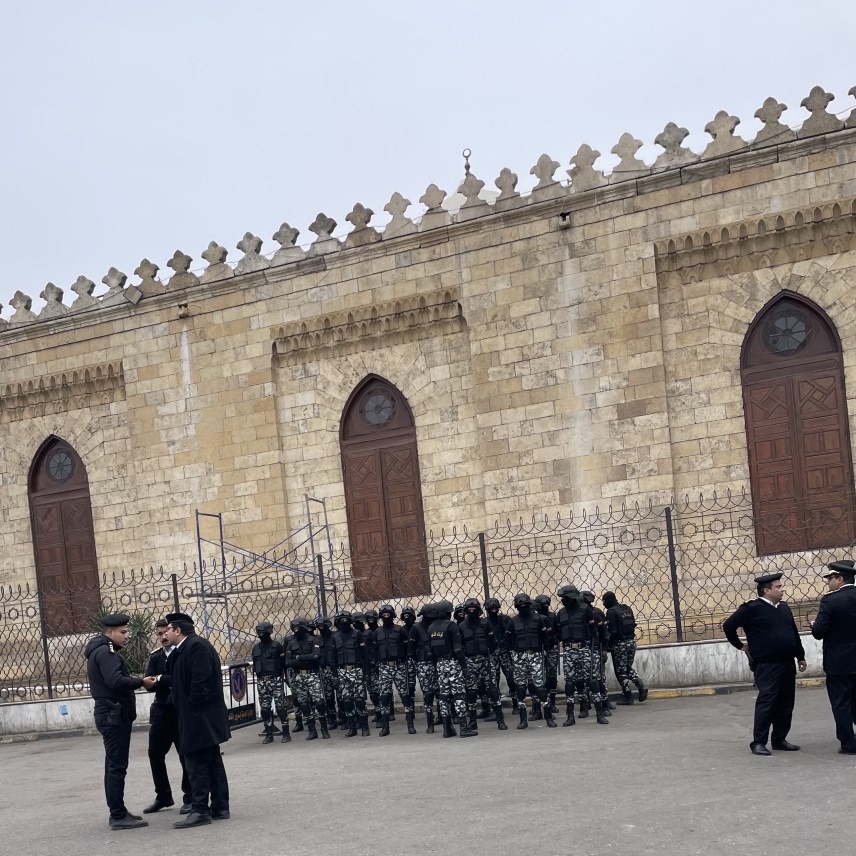
The international politics of Sisi are influenced by his hate of the Muslim Brotherhood: in Syria, after initially banning Bashar al-Assad from the Arab League, Egypt was one of the first countries to welcome him back in 2023.
When Al-Sharaa took over in December 2024, Egypt arrested several Syrians who celebrated the liberation of their country, and Sisi took time before meeting and welcoming Al-Sharaa. The blockade made on Qatar for several years was led by Egypt and Saudi Arabia for their support of the Muslim Brotherhood. Egypt had a cold war with Türkiye for years, since Erdogan opposed Sisi and denounced the coup. Egypt opposed Türkiye in the Libyan civil war by supporting Haftar, and met several times with the Greek, Cypriot, and Israeli leaders to sign agreements on the maritime areas that were contested by Türkiye. Since a few years ago, relationships with Türkiye and Qatar have been fixed, but several news outlets from both countries remain blocked in Egypt alongside websites of human rights organizations (using a VPN to access blocked websites is illegal in Egypt).
On Gaza, Egypt is a “neutral” negotiator for peace, but it is known that the Egyptian government dislikes Hamas. And there are several people who support the government who blame Hamas and the Palestinians for what happens in Gaza. Which is not surprising, as Hamas is the Muslim Brotherhood. And the Egyptian government repressed any foreigner who wanted to go to the Gaza border in the Sumud convoy. They were beaten by government thugs, arrested, and then expelled from Egypt. In 2017, Egypt arrested and expelled to China hundreds of Uyghur students of Al-Azhar, who were arrested and interrogated by Chinese officials in Egyptian jails, then expelled. They were accused of being potential terrorists, while the truth is Egypt is close to China and seeks to please Xi Jinping and decided to help him in his policy of control and repression of Uyghurs.
The government is secular but conservative of the traditional values. LGBT activists and influencers/singers who post/promote homosexuality have been jailed for “disrespecting the family values.” The government controls music videos and lyrics and doesn’t allow as much freedom as before. But that is mostly when they cause huge controversies online.
The government also condemns blasphemy while still allowing for “free-thinkers” to expose ideas that go against Islam or the traditional understanding of Islam, to “fight against extremist thoughts.” Speaking of “extremist,” as said previously, the niqab is seen as the expression of an extremist Islamist belief and has been banned in some places.
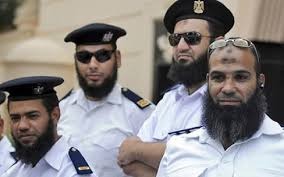
As mentioned, it is banned at Cairo University for teachers, but also in 2023 the government banned it for schoolgirls in public and private schools, and several MPs talked about a full national ban. But Niqab is only for women; men have beards, which is seen by some as the expression of a radical Islamist thought, taking Islamophobic stereotypes (which can be found in the Egyptian cinema). In 2018, Egypt forbade (again, as it was during the Mubarak era, but the ban was lifted under Morsi) policemen to have beards. With the lawyer who led the case to trial saying, “The beard in Arab countries is considered religious; it isn't just something normal. How do you feel when you cross a checkpoint run by bearded officers? These men are a threat to national unity and social peace.” Dozens of policemen were dismissed after the decision to ban the beard. Al-Azhar's position on the beard is that of Ali Gomaa, who stated in 2013 that the beard is a personal choice, not a religious obligation; thus, it explains why most Azhari scholars have either no beard or a closely trimmed one. Contrary to the Salafi scholars who have really long and thick beards, they both do it to distinguish themselves from each other and because Salafis defend the stance that shaving one's beard is forbidden in Islam, as the prophet said, "Let the beard grow and trim the moustache."
Though there is no debate to completely forbid the beard, one can have pressure from his family to trim or shave his beard, as it would “attract problems.” Even though I must say I never experienced troubles, I still had someone say to me, “Oh, are you a Muslim Brotherhood or with ISIS?” in a mocking tone just for my beard, which shows Islamophobic stereotypes are no longer foreign to the Arab world. I still must say that a lot of Egyptians still have (sometimes excessive) respect towards people who have beards. More surprisingly, Islamophobic behaviour has been put in place by some restaurants and other elitist companies. Women wearing hijab are not accepted as workers or customers. Some restaurants said it was a decision from the Ministry of Tourism and justified it, saying they have a bar with alcohol and thus cannot accept hijabis, but the minister of tourism denied taking such a decision and said discrimination because of religion is against Egyptian law. Though to this day, there is no news of those restaurants or companies being punished.
For the elites, hijab is seen as something that people from “lower classes” would wear. There is huge classism in Egypt, and people who are inferior to one’s class are mostly disregarded or even despised. Being seen as one of them is deemed insulting, so for the elites who are westernized (they studied in international schools in Egypt and learned to speak English or French sometimes even before Arabic, maybe even studied abroad, drinking alcohol is normalized even for people who identify as Muslim, etc.) Being associated with the middle class or lower classes by wearing a hijab is unacceptable.
In short, the government holds a nationalistic stance (defended by religious scholars with Khutbah on the importance of loving our country, which is “amongst the best in the world because God sent Yusuf and Musa in Egypt”), they care only about the affairs of Egypt, not other Arabs or Muslims; they are conservatives of traditional and some religious values but want to erase what they see as the “Islamist” influence and remain secular and westernized.
The future ?
The future of Egypt is uncertain; we probably know that Sisi is going to rule for several more years (maybe even until his death). Though the Constitution only allows him to rule for 3 terms (so until 2030), he already changed the constitution to make it from 2 to 3 terms and will probably have no trouble changing it again. His popularity waned over the years as the economy worsened with a huge external debt for his megaprojects, inflation rose up, and the money was devalued. In 2013, an American dollar was worth around 7 Egyptian pounds; in 2025, it is around 47 Egyptian pounds. But the opening of the new museum showed a lot of support for Sisi, with thousands of videos showing love and support for the museum, though it is hard to know among them who still dislikes Sisi and who is a bot. Some Egyptians did hate him, from day one to this day, and they still live in Egypt, but the repression from the early days left its mark.
I talked with someone in Egypt who told me, “There will be a revolution; the question is not ‘if’ but ‘when,’ and when it happens, it will be a violent revolution.” People are scared of another revolution, as it holds uncertainty and there will for sure be violence, but if the people reach a breaking point where they believe they have to try to change the government rather than stay as they are, they will probably try their chance with a revolution rather than die of hunger due to the economy.
Contrary to 2011, there is no real opposition to Sisi. If Sisi dies tomorrow, or a revolution overthrows him, there is not a single group or person that can claim to be the obvious choice after Sisi. He made sure to arrest anyone who dared lead people against him or even present himself to the presidential elections of 2019 (even in 2023’s elections he arrested a “dangerous” opposition candidate). The interesting question is, what would happen if Islamist leaders were freed from prison? It is quite utopian and probably won’t happen in the next few years, but if they were released, what would happen? Would the people support them? Nothing is certain.
Sources :
Please bare in mind that the bibliography has been formatted.
Books & Blog Sources:
Egypt on the brink: from Nasser to Mubarak, Tarek Osman, Yale University Press
Nasser’s blessed movement, Joel Gordon, AUC
Rainer Brunner. Maḥmūd Shaltūt. Handbook of Qurʾānic Hermeneutics. Vol. 4: Qurʾānic Hermeneutics in the 19th and 20th Century p.241-254, 2023 https://shs.hal.science/halshs-03494094v2/file/Qur%27anic_Hermeneutics--Shaltut--HAL_SHS.pdf
Prison Talk: The Muslim Brotherhood's Internal Struggle during Gamal Abdel Nasser's Persecution, 1954 to 1971, Barbara Zollner International Journal of Middle East Studies Vol. 39, No. 3 (2007), pp. 411-433 (23 pages) https://www.jstor.org/stable/30069528
Conflict and Cooperation between the State and Religious Institutions in Contemporary Egypt, Tamir Moustafa, International Journal of Middle East Studies Vol. 32, No. 1 (2000), pp. 3-22 (20 pages) https://www.jstor.org/stable/259533
Al-Arian, Abdullah. Heeding the Call: Popular Islamic Activism In Egypt (1970-1981). Georgetown University, 2011. hdl.handle.net/10822/558074
Özdemir, A. Y. From Hasan al-Banna to Mohammad Morsi; The Political Experience of Muslim Brotherhood in Egypt. https://www.academia.edu/28657443/From_Hasan_al_Banna_to_Mohammad_Morsi_The_Political_Experience_of_Muslim_Brotherhood_in_Egypt?nav_from=d7fae09f-2c11-49f9-a8bd-b74087907969
Egypt’s Foreign Policy under Mohamed Morsi, Mehmet ÖZKAN https://ozkanmehmet.com/yhoamsoo/2021/05/2013_Egypts-Foreign-Policy-under-Mohamed-Morsi.pdf
Web Sources:
The Brotherhood and Mubarak | Al Jazeera World. https://www.youtube.com/watch?v=VwBEzxXs0cI&t=3s
https://www.egyptindependent.com/local-recounts-prisoners-tales-forced-escape-wadi-al-natroun/
Egypt’s Morsi: The last hours. Al Jazeera https://youtu.be/BIlbZO2Gu9U?si=mTX73tMKsI-lGzwI
https://www.dailynewsegypt.com/2013/06/15/meshaal-arrives-in-cairo/
https://www.reuters.com/article/world/in-shift-by-egypt-president-meets-hamas-leader-idUSJOE86Q01F/
https://www.newarab.com/analysis/how-egyptian-army-primed-soldiers-kill-protesters
https://egyptwatch.net/2020/06/01/son-of-former-presidential-candidate-hazem-salah-arrested/
https://www.amnesty.org/en/latest/press-release/2014/03/egypt-more-sentenced-death-grotesque-ruling/
https://www.icj.org/egypt-end-widespread-and-systematic-enforced-disappearances/
https://www.egypttoday.com/Article/10/39/Al-Azhar-Awakening
https://www.middleeastmonitor.com/20140127-ali-gomaa-kill-them-they-stink/
https://www.egypttoday.com/Article/1/6853/Al-Azhar-supports-Arab-leaders-attitude-towards-Qatar
https://indembassy-amman.gov.in/world-sufi-forum.html
https://chechnyaconference.org/material/chechnya-conference-statement-english.pdf
https://eipr.org/en/blog/ishak-ibrahim/2020/05/controversy-banning-niqab-public-egypt
https://www.dar-alifta.org/images/Languages/OnlineBooks/The%20Ideological%20Battle.pdf
https://www.dailynewsegypt.com/2014/12/17/71-al-azhar-students-expelled-protesting/
https://www.voanews.com/a/student-protests-at-egypts-al-azhar-challenge-army/1773751.html
https://www.arabnews.com/node/2223901/%7B%7B
https://www.fides.org/en/news/62268-
https://www.youtube.com/watch?v=sLoD4ybJQaw (exchange between Sisi and Azhari phd students)
https://www.egypttoday.com/Article/1/65189/Muslim-Brotherhood-follows-ISIS-s-lead-Al-Azhar-Observer
https://thearabweekly.com/al-azhar-grand-imam-sparks-polygamy-rethink
https://www.middleeasteye.net/news/egypts-al-azhar-sacks-head-university-amid-power-games-sisi
https://www.youtube.com/watch?v=ku4NM2Y6uf4 (Ali Gomaa: jews and christians are going to paradise)
https://www.youtube.com/watch?v=2O-zRePw1-w&t=94s (Ahmed Karima on jews and christians)
https://youtube.com/shorts/yUnFyecUBy4?si=xqHZKoCyRWBRHuu- (Ahmed Karima on Salafis)
https://youtube.com/shorts/CUv88X6U9x4?si=UZfK03h0h-DzUBn5 (Mawlid al sayyed Badawi with the attendance of Ali Gomaa and Minister of Awqaf Usama al Azhari)
https://www.dar-alifta.org/en/fatwa/details/4781/are-all-christians-going-to-enter-hell-fire
https://www.middleeasteye.net/news/popular-egyptian-preacher-silenced-following-spat-tv-personality
https://daraj.media/en/egypt-salafist-tv-sheikh-renounces-salafism-in-court/
https://www.middleeasteye.net/news/egypt-court-islamists-sentenced-die-are-pro-jewish-demons
https://mecouncil.org/publication/egypt-and-turkiye-a-pragmatic-turn/
https://www.anthropology-news.org/articles/cairo-between-dystopia-and-umm-al-dunya/
https://www.aljazeera.com/features/2017/7/27/uighurs-arrested-in-egypt-face-unknown-fate
https://www.africanews.com/2023/09/12/egypt-ban-on-face-veil-in-schools-sparks-debate/
https://www.newarab.com/news/egypts-police-lose-court-battle-keep-their-beards
https://www.bbc.com/news/world-middle-east-44411333 (hijab ban in some restaurants)
https://www.arabnews.com/node/2152151/midden-oosten (hijab ban in some restaurants)